
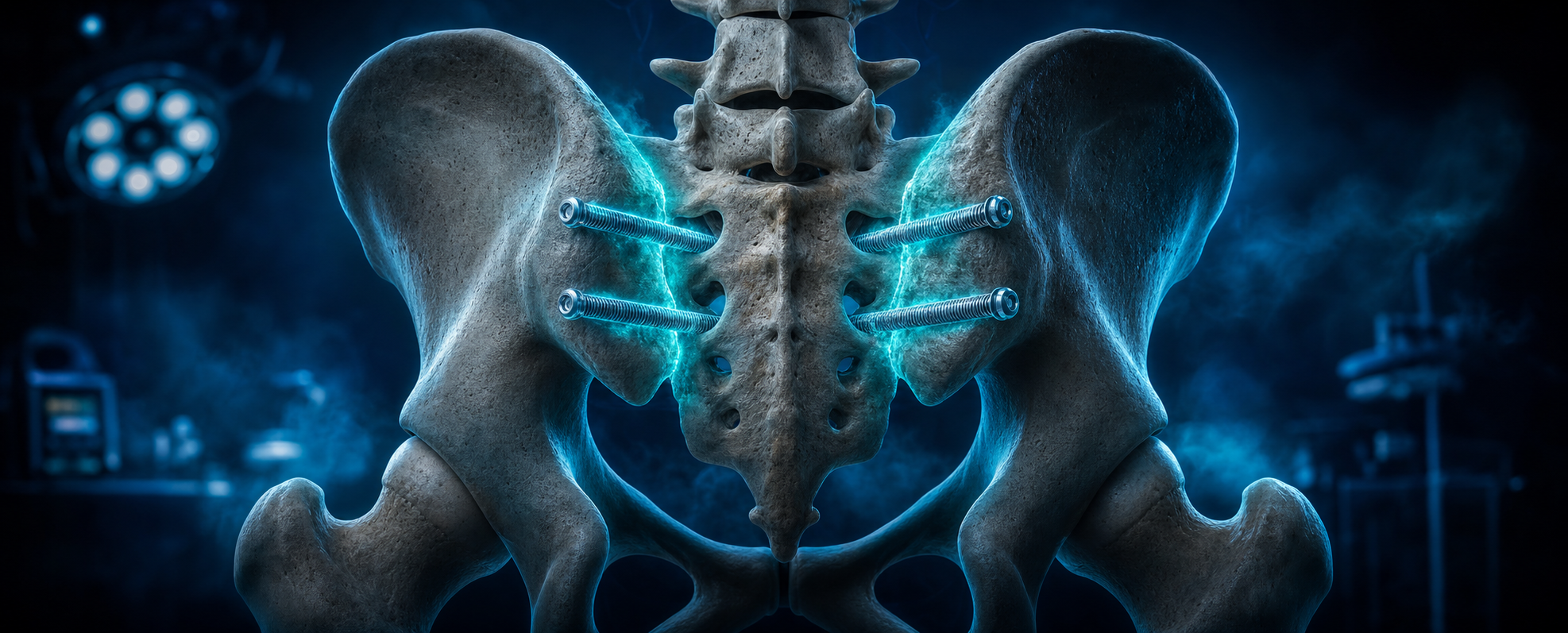
SI Joint Fusion
What Is SI Joint Fusion?
The sacroiliac (SI) joint connects the base of the spine (sacrum) to the pelvis. When this joint becomes inflamed, degenerated, or hypermobile, it can cause debilitating low back, buttock, and leg pain. SI joint fusion is a minimally invasive procedure in which small titanium implants are placed across the SI joint to stabilize and eventually fuse it, eliminating painful joint motion.
How It Works
•Through a small incision on the side of the buttock, a series of triangular titanium implants are inserted across the SI joint under fluoroscopic guidance.
•The implants are designed with a porous surface that encourages bone in-growth, promoting natural fusion of the joint over 6–12 months.
•Once fusion occurs, the abnormal joint motion that caused pain is permanently eliminated.
What to Expect During the Procedure
•Preparation: The area is prepped and local anesthetic is administered; general or spinal anesthesia is typically used.
•Duration: The procedure takes approximately 30–60 minutes.
•Incision: A small lateral incision (2–3 cm) provides access to the joint.
•Guidance: Real-time fluoroscopy is used throughout to ensure precise implant placement.
•Hospital stay: Most patients go home the same day or after an overnight observation.
Conditions Treated
•Sacroiliac joint dysfunction (SI joint syndrome)
•Degenerative sacroiliitis
•Inflammatory sacroiliitis (non-infectious)
•SI joint disruption or instability
•Low back pain confirmed to originate from the SI joint via diagnostic injection
Who Is a Good Candidate?
Adults with chronic, confirmed SI joint pain — typically lasting more than 6 months and not responsive to physical therapy, medications, or SI joint injections — are the most appropriate candidates. A positive response to a diagnostic SI joint block is often required before fusion is recommended.
Recovery & Results
Weight-bearing is typically restricted or limited for 2–4 weeks following surgery, with most patients walking with assistance the day of or after the procedure. Full fusion and maximum pain relief are generally achieved over 6–12 months. Studies show that the majority of appropriately selected patients experience significant, lasting improvement in pain and function. Physical therapy begins once the implants are stable, usually within 4–6 weeks.
Frequently Asked Questions
How do I know my pain is coming from the SI joint?
A diagnostic SI joint injection with a local anesthetic is the gold standard for confirming the SI joint as the pain source. If you experience 75% or greater pain relief after the injection, you are likely a good fusion candidate.
Will I lose movement in my pelvis after fusion?
The SI joint has very limited natural movement (1–4 degrees). Most patients do not notice a change in flexibility after fusion, as the joint was already stiff due to pain and inflammation.
How long until I can return to work?
Return to sedentary work may be possible within 1–2 weeks. Physical jobs may require 4–6 weeks or longer depending on activity requirements.