
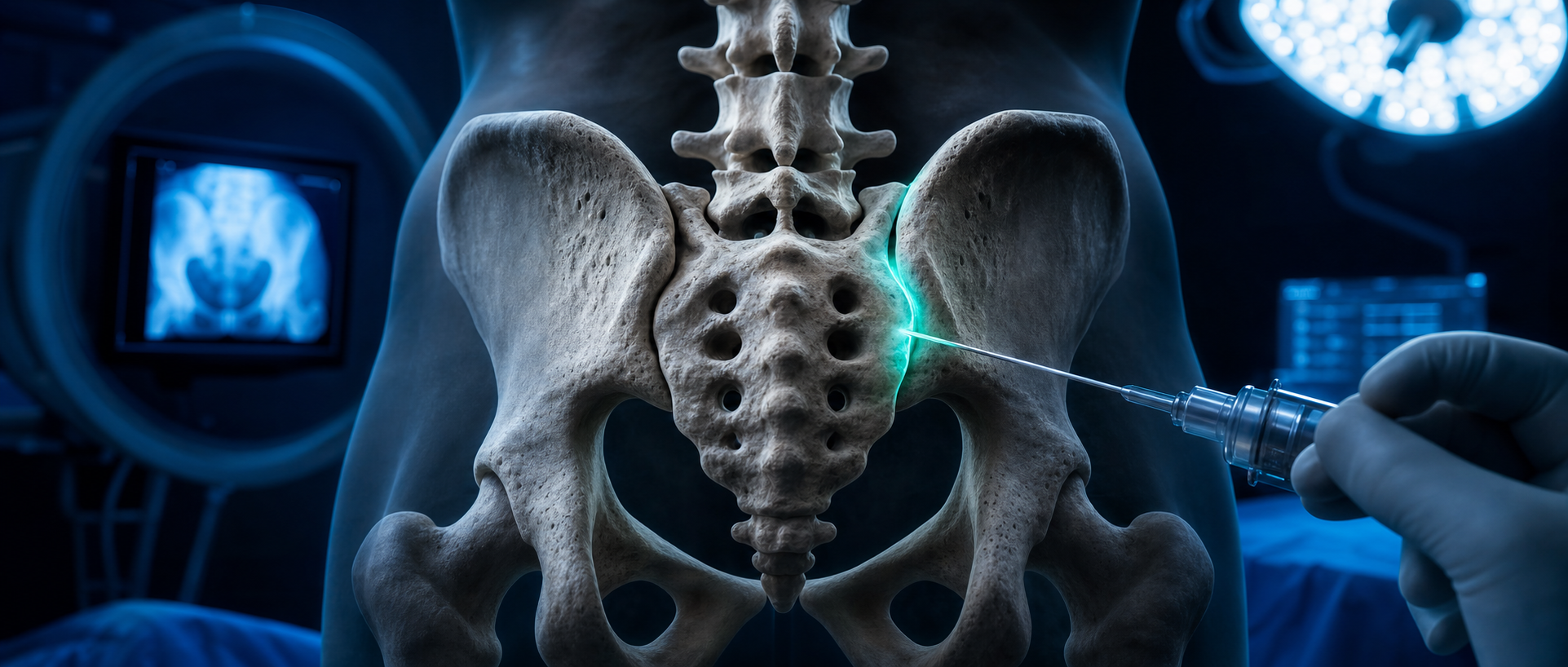
Sacroiliac (SI) Joint Injection
What Is a Sacroiliac Joint Injection?
The sacroiliac (SI) joints connect the sacrum — the triangular bone at the base of your spine — to the iliac bones of the pelvis. When these joints become inflamed or dysfunctional, they can cause significant pain in the lower back, buttock, hip, or even the thigh. An SI joint injection delivers a precise combination of local anesthetic and corticosteroid into the joint to reduce inflammation and confirm or rule out the SI joint as a pain source.
How It Works
Under fluoroscopic or ultrasound guidance, a needle is directed into the SI joint space. A small volume of contrast dye is first injected to confirm correct placement, followed by the anesthetic-steroid mixture. The anesthetic provides rapid short-term relief, while the corticosteroid works over days to reduce joint inflammation and provide longer-lasting pain control.
•Contrast dye confirms accurate needle placement within the joint
•Local anesthetic provides rapid diagnostic relief
•Corticosteroid reduces inflammation for sustained pain reduction
•Image guidance ensures safety and precision in a deep, irregularly shaped joint
What to Expect During the Procedure
•Preparation: You lie face-down; the overlying skin is sterilized and numbed
•Duration: 20–30 minutes from start to finish
•Guidance: Fluoroscopy or ultrasound imaging guides the needle into the joint
•Anesthesia: Local anesthetic at the entry site; mild pressure may be felt during the injection
•Same-day recovery: Rest in the recovery area for 20–30 minutes; arrange a driver for your ride home
Conditions Treated
•Sacroiliac joint dysfunction
•Sacroiliitis (joint inflammation)
•Ankylosing spondylitis (inflammatory arthritis of the SI joint)
•Post-pregnancy pelvic girdle pain
•Degenerative SI joint arthritis
•Hip bursitis with secondary SI joint involvement
Who Is a Good Candidate?
Patients experiencing pain at or below the beltline — particularly in the buttock, hip, or upper thigh — that does not clearly originate from a lumbar disc or facet joint may benefit from SI joint evaluation. This injection is especially helpful when physical exam maneuvers that stress the SI joint reproduce the patient's familiar pain.
Recovery & Results
Soreness at the injection site is expected for 24–48 hours. Pain relief from the steroid typically develops within 3–7 days and can last several weeks to months. A positive response to the anesthetic component also helps confirm the SI joint as the pain generator, guiding future treatment planning. If multiple injections provide only short-term relief, your physician may discuss lateral branch radiofrequency ablation as a longer-term option.
Frequently Asked Questions
Q: How do I know if my pain is coming from the SI joint?
A: SI joint pain typically presents as lower back and buttock pain, sometimes radiating into the thigh. Your Echo PMR physician will perform a focused physical examination and review your imaging before recommending this injection.
Q: Can SI joint injections be repeated?
A: Yes. Most patients can receive up to three injections per year. If relief is consistent but short-lived, your physician may explore other options such as radiofrequency ablation.
Q: What is the success rate of SI joint injections?
A: Studies show that a majority of appropriately selected patients experience meaningful pain relief. Results are best when the SI joint is clearly identified as the primary pain source through examination and response to the anesthetic component of the injection.