
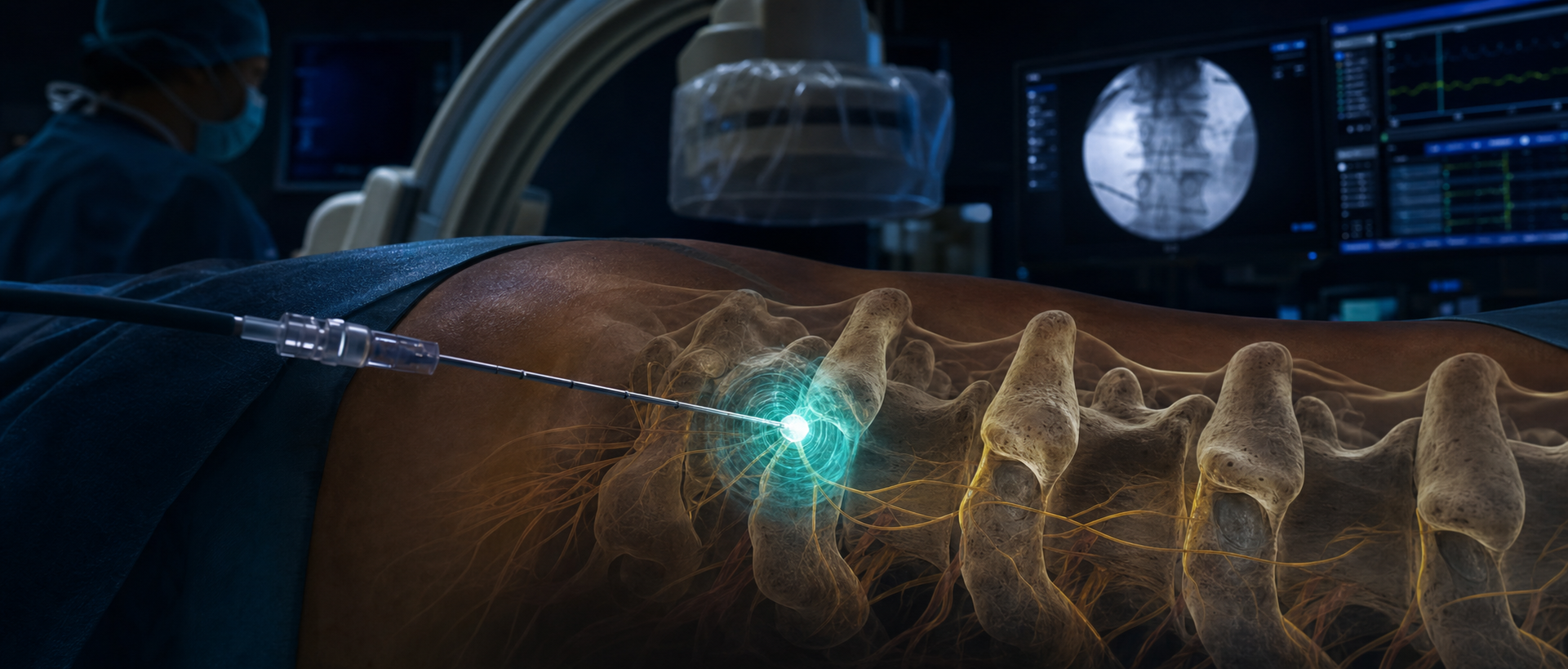
Radiofrequency Ablation (RFA)
What Is Radiofrequency Ablation?
Radiofrequency ablation (RFA), also known as radiofrequency neurotomy, is a minimally invasive procedure that uses heat generated by radio waves to interrupt pain signals traveling through the medial branch nerves to the brain. By disabling these nerves, RFA can provide significant, long-lasting relief from chronic facet joint pain in the neck, mid-back, or lower back. It is performed only after two positive diagnostic medial branch blocks confirm the facet joint as the pain source.
How It Works
A specialized radiofrequency probe is guided to the medial branch nerve under fluoroscopic imaging. Once in position, the probe delivers controlled heat (approximately 80°C / 176°F) to create a small lesion on the nerve, preventing it from transmitting pain signals. The procedure does not damage surrounding structures and the nerve may regenerate over time, at which point the procedure can be repeated.
•Radiofrequency energy heats the nerve tissue to disable pain transmission
•Fluoroscopic guidance ensures the probe is precisely positioned
•Results typically develop over 1–4 weeks as inflammation resolves
•Duration of relief commonly lasts 12–24 months; repeatable upon nerve regeneration
What to Expect During the Procedure
•Preparation: Light sedation is available; the skin and deeper tissue are numbed with local anesthetic
•Duration: 30–60 minutes depending on the number of levels treated
•Guidance: Real-time fluoroscopy is used throughout the procedure
•Anesthesia: Local anesthetic with optional mild IV sedation for comfort
•Same-day recovery: Observation for 30–60 minutes; arrange a driver; expect soreness at the treated levels for 1–2 weeks
Conditions Treated
•Lumbar facet joint arthropathy
•Cervical facet-mediated neck pain
•Thoracic facet pain
•Chronic low back pain from spondylosis
•Whiplash-related cervical facet pain
•Sacroiliac joint pain (lateral branch RFA)
Who Is a Good Candidate?
Patients who have completed two diagnostic medial branch blocks with at least 50–80% documented pain relief are strong candidates for RFA. Ideal patients have chronic axial spine pain that significantly limits daily function and have not achieved durable results from physical therapy, medications, or steroid injections alone.
Recovery & Results
It is common to experience increased soreness in the treated area for 1–2 weeks following RFA as the nerve tissue responds to the procedure. Full relief typically develops over 2–6 weeks. Most patients enjoy significant pain reduction lasting 12–24 months. Because the medial branch nerve can regenerate, the procedure can be safely repeated if pain returns. Many patients use the relief window to actively engage in physical therapy and rehabilitation.
Frequently Asked Questions
Q: Is radiofrequency ablation permanent?
A: The relief is long-lasting but not always permanent. Medial branch nerves can regenerate over 12–24 months, at which point RFA can be repeated. Some patients experience sustained relief with multiple treatment cycles.
Q: Does RFA affect the function of my spine?
A: The medial branch nerves treated carry only pain signals, not motor function. Disabling them does not affect your ability to move or control your back muscles.
Q: How is RFA different from a steroid injection?
A: Steroid injections reduce inflammation and typically provide relief lasting weeks to months. RFA directly disables the nerve transmitting pain and can provide relief lasting 12–24 months. RFA requires a confirmed diagnosis via prior diagnostic blocks.