
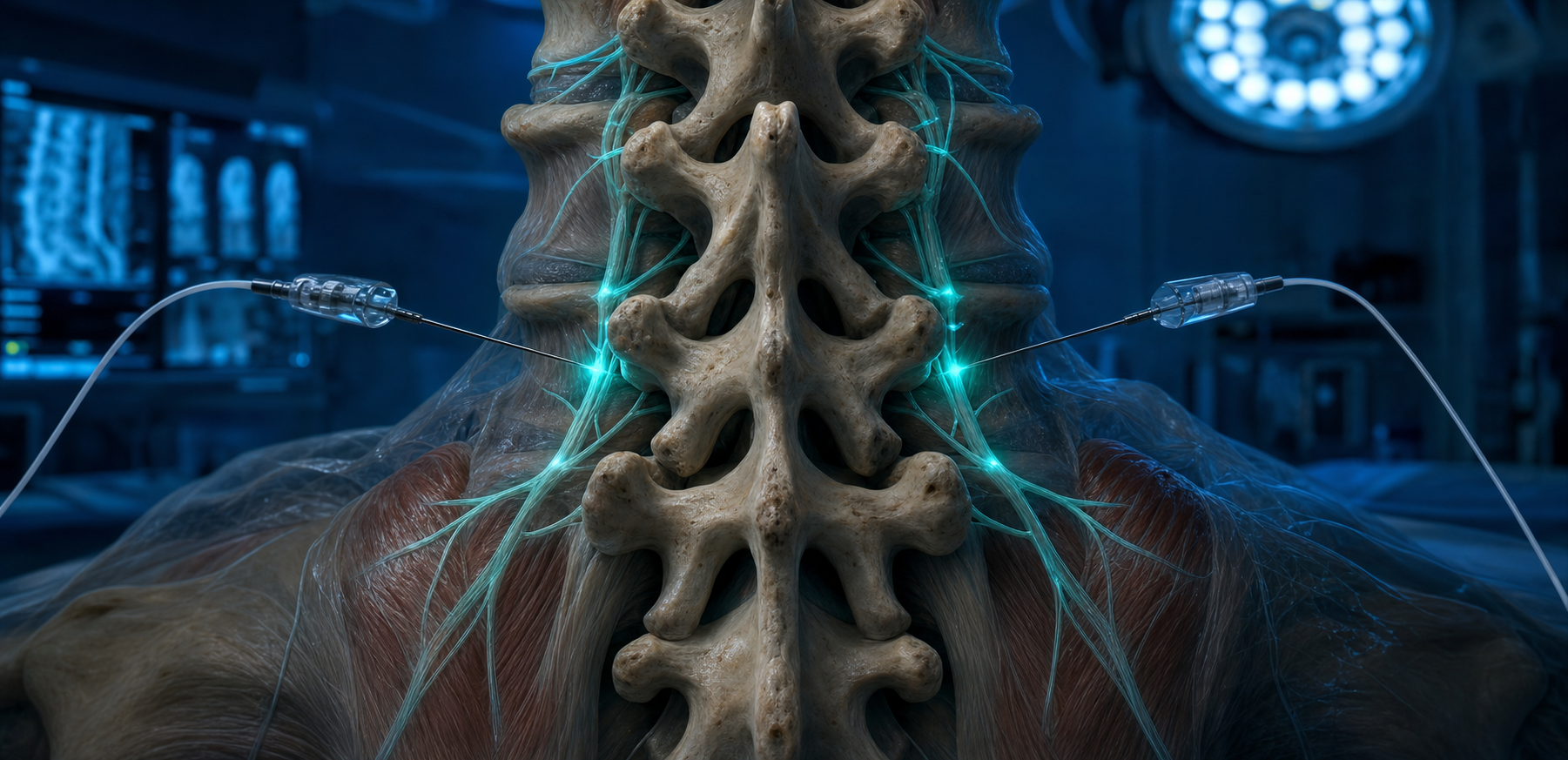
Medial Branch Block
What Is a Medial Branch Block?
The medial branch nerves are tiny nerves that branch off the spinal nerves and transmit pain signals from the facet joints to the brain. A medial branch block (MBB) is a targeted injection of local anesthetic around these nerves to temporarily interrupt that signal. It is primarily used as a diagnostic tool to determine whether the facet joints are responsible for a patient's pain — and is the required prerequisite before radiofrequency ablation (RFA).
How It Works
Under fluoroscopic guidance, a physician places a needle near the medial branch nerve at the affected spinal level. A small volume of local anesthetic is injected to block nerve conduction. If the patient's familiar pain decreases by 50–80% or more during the anesthetic window, the test is considered positive and the facet joint is confirmed as the pain generator.
•Numbing agent blocks nerve signal temporarily (typically 4–8 hours)
•Pain diary completed by the patient after the procedure to document relief percentage
•Two diagnostic blocks are typically required before proceeding to RFA
•No steroid is used in a standard diagnostic MBB
What to Expect During the Procedure
•Preparation: You lie face-down; skin is prepped and a local anesthetic is applied to the surface
•Duration: 10–20 minutes; multiple levels may be treated in one session
•Guidance: Fluoroscopy provides real-time imaging for accurate needle placement
•Anesthesia: Local anesthetic at the skin; the procedure itself is generally well-tolerated
•Same-day recovery: Brief observation period; pain diary instructions given before you leave
Conditions Treated
•Lumbar facet syndrome
•Cervical facet-mediated pain (neck pain, occipital headaches)
•Thoracic facet pain
•Spondylosis and spinal osteoarthritis
•Axial back or neck pain not explained by disc herniation
•Whiplash-associated facet injury
Who Is a Good Candidate?
Patients with persistent axial spine pain (localized to the neck or back) that has not responded to physical therapy or other conservative measures and where facet arthritis is suspected on imaging are ideal candidates. A positive MBB result makes these patients excellent candidates for radiofrequency ablation.
Recovery & Results
Because the medial branch block uses only local anesthetic, the pain relief is temporary — typically lasting a few hours. The goal is not to treat pain but to identify its source. Patients are asked to keep a pain diary on the day of the procedure, rating their relief throughout the anesthetic window. A second confirmatory block is typically performed before RFA is approved to ensure accurate diagnosis.
Frequently Asked Questions
Q: Why do I need two medial branch blocks before radiofrequency ablation?
A: Two separate positive blocks are required by most insurers and clinical guidelines to confirm the diagnosis with high confidence and reduce the risk of performing RFA on the wrong pain source.
Q: Will I feel normal pain relief from the injection?
A: The anesthetic effect is temporary — usually 4–8 hours. Your regular pain will return after the block wears off. This is expected and does not mean the procedure failed.
Q: Can a medial branch block treat pain permanently?
A: No. The MBB itself is a diagnostic tool. If it confirms the facet joint as your pain source, your physician may recommend radiofrequency ablation for long-lasting relief.