
Joint Injections (Ultrasound-Guided)
What Is an Ultrasound-Guided Joint Injection?
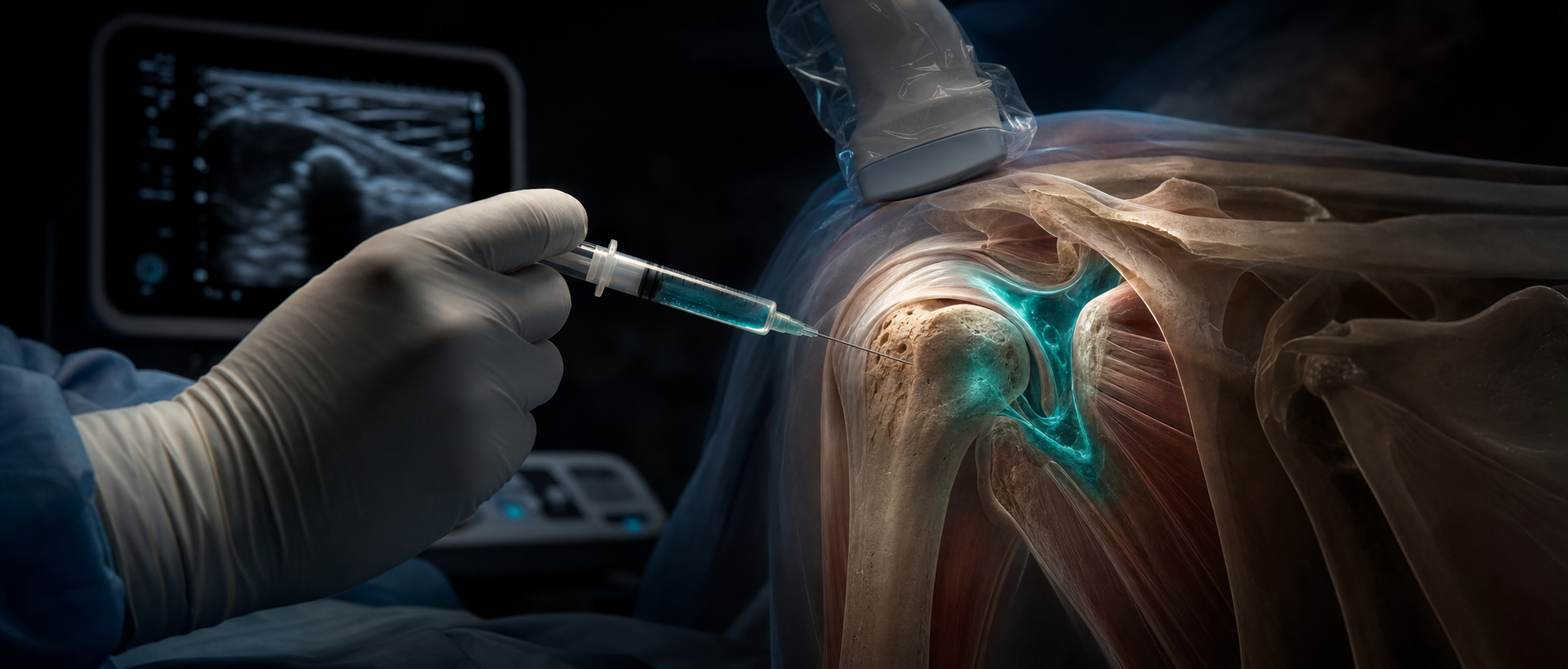
A joint injection delivers corticosteroid, hyaluronic acid, or other therapeutic agents directly into a painful joint to reduce inflammation and provide relief. When guided by real-time ultrasound imaging, the physician can visualize the needle, joint space, and surrounding structures simultaneously — ensuring the medication is placed precisely where it will do the most good. Ultrasound guidance significantly improves accuracy compared to landmark-based injections, especially in deep or complex joints.
How It Works
•A high-frequency ultrasound probe is placed on the skin overlying the target joint, producing a live image of the internal structures.
•A thin needle is advanced under continuous ultrasound visualization into the joint space.
•The therapeutic agent — typically a corticosteroid combined with a local anesthetic, or hyaluronic acid for knee and hip arthritis — is injected directly into the joint.
What to Expect During the Procedure
•Preparation: The skin is cleaned and numbed with a topical or injectable local anesthetic.
•Duration: The injection itself takes 5–15 minutes; the full appointment is typically 30 minutes.
•Anesthesia: Local anesthetic only; no sedation is required.
•Guidance: Real-time ultrasound is used throughout to confirm needle position before injection.
•Same-day recovery: Patients rest briefly and return home; driving is permitted in most cases.
Conditions Treated
•Osteoarthritis of the knee, hip, shoulder, or ankle
•Rheumatoid arthritis flares
•Rotator cuff tendinopathy and shoulder impingement
•Gout and crystal arthropathy
•Post-traumatic joint pain and effusion
•Synovitis and joint inflammation
Who Is a Good Candidate?
Patients with moderate-to-severe joint pain from arthritis, inflammation, or injury who have not found lasting relief with oral medications, physical therapy, or topical treatments are good candidates. Ultrasound-guided injections are particularly beneficial for patients with complex joint anatomy, obesity, or prior failed injections.
Recovery & Results
Mild soreness at the injection site is normal for 24–48 hours. The local anesthetic provides immediate short-term relief, while the corticosteroid takes effect over 3–7 days. Many patients experience 2–6 months of meaningful pain relief per injection. Hyaluronic acid injections (for knee and hip) may provide cumulative benefit with a series of 3–5 weekly injections.
Frequently Asked Questions
How often can I receive joint injections?
Most physicians recommend limiting corticosteroid injections to 3–4 times per year in a single joint, as frequent high-dose injections can affect cartilage over time. Your Echo PMR provider will develop a personalized plan.
Does the injection hurt?
The skin is numbed beforehand, so most patients feel only mild pressure during the injection. Any post-procedure soreness typically resolves within 1–2 days.
Can ultrasound-guided injections replace surgery?
For many patients, regular injections combined with physical therapy can significantly delay or avoid surgery. Whether injections are a long-term solution depends on the underlying condition and its progression.