
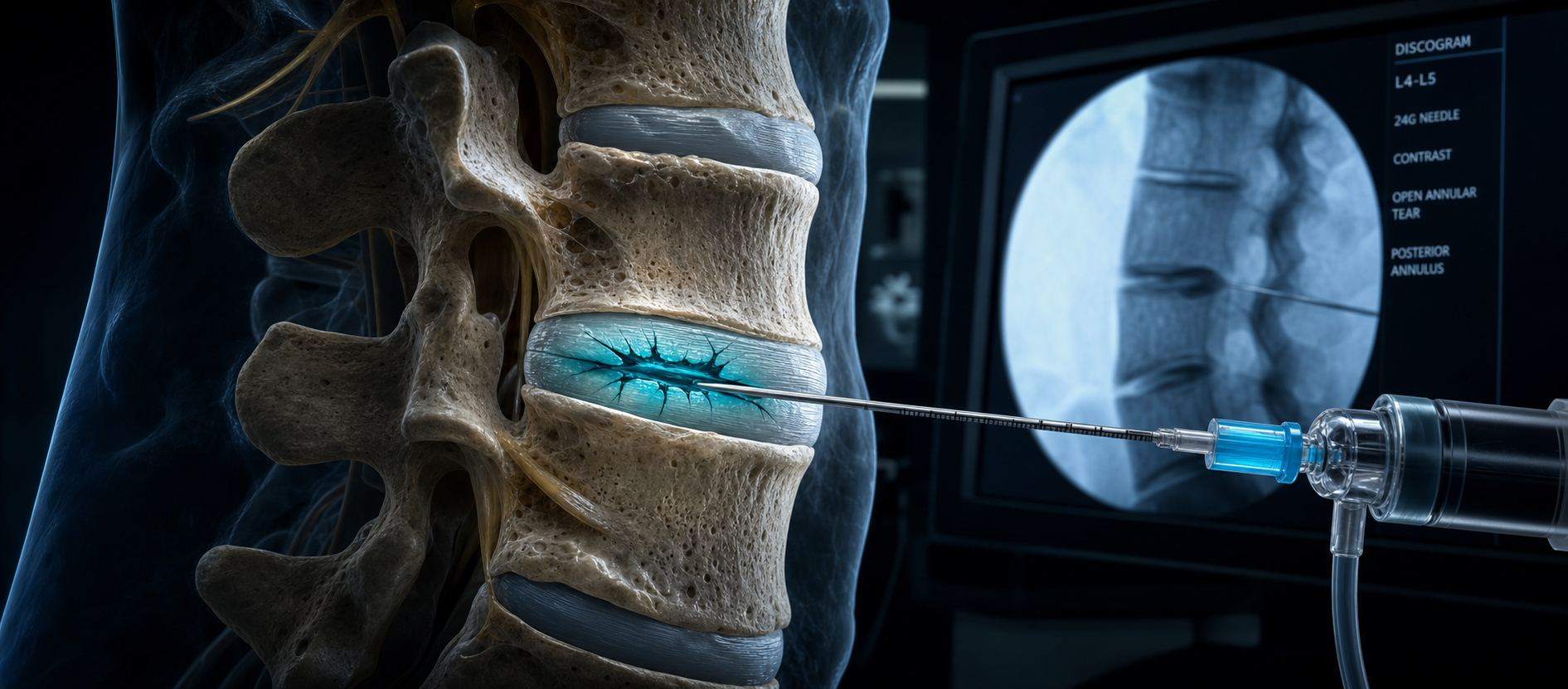
Discogram (Discography)
What Is a Discogram?
A discogram, or discography, is a diagnostic procedure designed to identify which spinal disc or discs are causing a patient's chronic back pain. Unlike MRI, which shows disc anatomy, a discogram tests whether a disc is actually the source of pain by pressurizing it and observing the patient's response. This information is critical for guiding decisions about spinal surgery, disc replacement, or other advanced interventions.
How It Works
A needle is advanced into the center of each disc being evaluated (called the nucleus pulposus) under fluoroscopic guidance. A contrast dye is then injected to pressurize the disc. The key information is whether this provokes the patient's familiar or "concordant" pain. Normal discs typically show no pain or only pressure; painful discs reproduce the patient's symptoms. Post-procedure CT imaging is often obtained to assess internal disc structure.
•Provocation test: Pressurizing the disc replicates familiar pain if that disc is the source
•Concordant pain: The patient recognizes the induced pain as their usual pain — this is a positive finding
•Post-procedure CT: Provides detailed imaging of internal disc disruption not visible on MRI alone
•Multiple discs tested: Adjacent levels are evaluated as controls
What to Expect During the Procedure
•Preparation: You will be positioned face-down; IV access is established for antibiotics and sedation
•Duration: 30–60 minutes depending on the number of discs tested (typically 3–5 levels)
•Guidance: Fluoroscopy is used to precisely navigate the needle into each disc
•Anesthesia: IV sedation for relaxation, but patients must be conscious enough to accurately report pain response
•Same-day recovery: More soreness is expected than after most injections; rest is recommended for 24–48 hours
Conditions Treated
•Chronic discogenic low back pain
•Internal disc disruption
•Pre-surgical evaluation for lumbar fusion
•Evaluation prior to disc replacement (arthroplasty)
•Multi-level disc degeneration requiring level-specific pain mapping
•Recurrent back pain after prior spinal surgery
Who Is a Good Candidate?
Discography is reserved for patients with chronic, debilitating disc-related back pain that has not responded to extensive conservative treatment and who are considering surgical or advanced interventional options. Candidates should be psychologically stable, willing to participate actively during the procedure, and have MRI findings consistent with disc degeneration at the suspected levels.
Recovery & Results
Patients typically experience increased back soreness for 24–72 hours following discography. Activity should be limited, and arrangements for a driver and caregiver are recommended. The procedure itself does not provide pain relief — its value is entirely diagnostic. Results guide your physician and surgeon in creating a targeted treatment plan, whether that includes spinal fusion, minimally invasive disc procedures, or continued conservative care.
Frequently Asked Questions
Q: Does a discogram hurt?
A: The procedure is designed to provoke familiar pain at symptomatic discs, so it can be uncomfortable. IV sedation is provided for relaxation, but patients must remain alert enough to report their pain responses accurately. Normal discs typically feel only pressure, not pain.
Q: How is a discogram different from an MRI?
A: MRI shows the anatomy and structure of discs. A discogram tests whether a disc actually generates pain when pressurized. Some degenerated-looking discs on MRI are not painful; a discogram helps identify the true pain generator.
Q: Will I need surgery after a discogram?
A: Not necessarily. A positive discogram is one piece of data your care team uses to make recommendations. Some patients proceed to minimally invasive procedures like percutaneous disc decompression, while others may pursue fusion or other surgical options.